


If you have ever discovered damp carpet, pooling floor water, or efflorescence along your basement walls after a severe Mid-Atlantic storm, you have likely started researching basement waterproofing. During your search, two terms come up constantly: interior French drains and sump pumps. A common misconception is that homeowners must choose one or the other. In reality, these two systems perform distinct roles and work in tandem to keep lower levels dry.
Demystifying Basement Water Intrusion in the DMV
Homes across Maryland, Washington, D.C., and Northern Virginia sit on heavy clay soils that retain water long after heavy rains end. As rainwater saturates the ground around your home, it creates intense hydrostatic pressure against foundation walls and sub-slab footings. Water naturally seeks the path of least resistance, which usually leads it straight through vertical wall cracks, porous concrete blocks, or the critical cove joint—the seam where the basement floor slab meets the foundation wall.
To eliminate basement water intrusion permanently, a system must do two things: collect water before it reaches your living space and expel it safely away from your property. This is where French drains and sump pumps divide and conquer.
What Is an Interior French Drain System?
An interior French drain (also called a sub-slab perimeter drainage channel) acts as the collection network for your basement waterproofing strategy.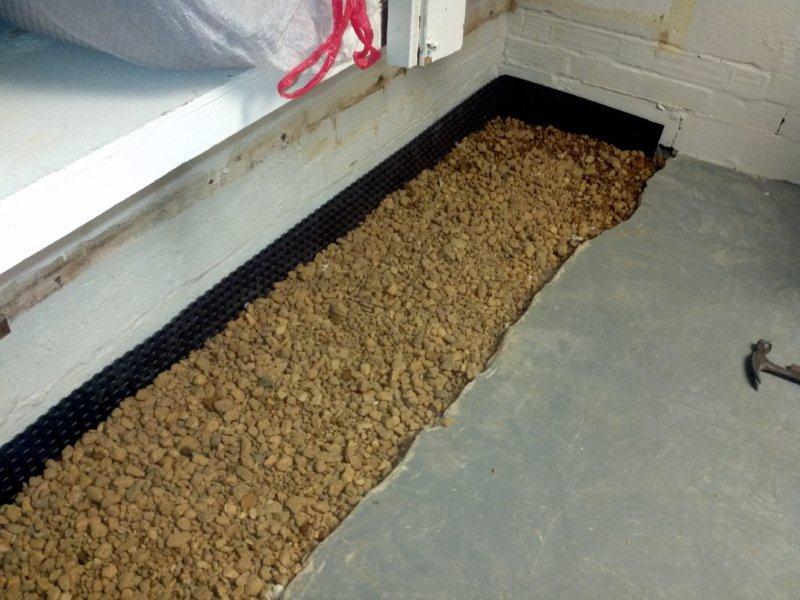
Installation involves cutting a narrow trench along the interior perimeter of the basement floor slab down to the foundation footings. A perforated, heavy-duty drainage pipe is laid inside the channel, surrounded by aggregate filter gravel, and sealed beneath new concrete flush with the floor. Wall vapor barriers or weep holes direct incoming wall seepage straight into the hidden drain below.
Primary Role: Relieves hydrostatic pressure at the footing level and captures groundwater entering along walls and cove joints before it reaches your basement floor.
What Is a Sump Pump System?
While a French drain collects water around your home’s perimeter, it cannot remove the water on its own. A sump pump serves as the expulsion engine of the waterproofing system.
A heavy-duty sump pit (or basin) sits at the lowest point of your basement floor and houses a mechanical cast-iron pump. As the interior French drain channels groundwater into the basin, the water level rises and lifts an automatic float switch. The pump engages, forcing collected water up through a dedicated discharge pipe and depositing it far outside your home away from the foundation wall.
Primary Role: Actively pumps collected groundwater up, out, and away from your home’s interior.
French Drain vs. Sump Pump: A Side-by-Side Comparison
| System Feature | Interior French Drain | Sump Pump System |
|---|---|---|
| Primary Function | Captures and channels groundwater underground | Pumps collected water up and out of the home |
| Location | Sub-floor perimeter along foundation footings | Recessed pit at the lowest basement floor point |
| Power Source | Passive gravity flow | Requires electricity (AC power + battery backup) |
| Solves Which Problem? | Cove joint leaks, wall seepage, sub-slab pressure | Basement flooding, pooling basin water |
Why Most DMV Basements Need Both Systems Working Together
Relying on only one of these components leaves your foundation vulnerable:
- Sump Pump Without a French Drain: A sump pump can only discharge water that physically reaches its basin. Without a perimeter French drain to feed it, water entering distant corners or floor-wall joints will still pool on your basement floor before reaching the pit.
- French Drain Without a Sump Pump: Unless your property sits on a steep grade that lets gravity discharge water out to daylight, a French drain without a pump will simply fill up like an underground moat and overflow back into your basement.
By pairing a high-capacity interior drainage network with a primary sump pump—plus a dedicated battery backup system for power outages—you establish a complete, lifetime defense system against Mid-Atlantic storms.
Frequently Asked Questions
Can an interior French drain work without a sump pump?
Only if your home is built on a hillside or steep slope where the drainage pipe can slope downward to exit naturally above grade (“gravity discharge”). Most residential properties in MD, DC, and VA require a mechanical sump pump to lift water out of the sub-grade pit.
Will installing an interior French drain ruin my finished basement?
Professional installation requires removing a narrow border of drywall and flooring along perimeter walls to trench concrete. Once the drainage pipe and gravel are set, the floor is neatly restored with smooth concrete, ready for subflooring and refinishing.
How do I know if water is coming from the cove joint?
If you notice water dampening the floor right along the edge where walls meet the concrete floor—especially without active top-of-wall leaks—it is classic cove joint seepage caused by rising underground hydrostatic pressure.
Get a Custom-Engineered Drainage Solution for Your Home
Stop worrying about rising groundwater and storm runoff. Protect your basement and foundation with regional experts who have served MD, DC, and VA for over 35 years. Contact AquaGuard Waterproofing today for your free, no-obligation basement inspection.

Having started in 1990, we boast expert staff members with collective experience in the industry going strong for over 50 years. We promise our clients superior workmanship and quality in basement waterproofing and foundation repair at budget-friendly prices, capped by a fantastic client experience to ensure your ultimate satisfaction.
We are a local and family-owned business committed to providing top-notch basement waterproofing service and workmanship. We are also actively involved in several non-profit projects for the betterment of our community. In 2025 we celebrated 35 years.